
Why Process Stability Has Become a Competitive Advantage
Industrial manufacturing has entered a new era. Producing more at a lower cost is no longer enough to remain competitive. Today's manufacturers are expected to deliver consistent quality, improved efficiency, reduced environmental impact, and greater flexibility—all while operating in increasingly dynamic production environments.
In this context, process stability has become one of the most valuable yet often underestimated competitive advantages.
Across industries—whether plastics, food, chemicals, pharmaceuticals, or precision engineering—manufacturers depend on processes that perform consistently over thousands, sometimes millions, of cycles. What once were considered minor variations can now translate into significant costs, affecting product quality, increasing waste, or disrupting production.
Among all influencing variables, temperature plays a central role.
It directly impacts material properties, reaction behavior, cycle times, and dimensional accuracy. Yet maintaining stable thermal conditions is becoming more complex, as modern production rarely operates under fixed conditions. Production loads fluctuate, systems are shared across multiple machines, and ambient temperatures continuously evolve.
As a result, industrial cooling can no longer be treated as a simple utility. It has become an integral part of process control, with a direct influence on operational performance and profitability.
This shift is also changing how cooling systems are evaluated. Manufacturers are moving beyond nominal capacity and purchase price, focusing instead on real-world consistency under variable conditions.
Ultimately, process stability is no longer just an engineering goal—it is a strategic driver of quality, efficiency, and competitiveness.
Understanding Why Temperature Stability Matters
Industrial Processes Are Never Truly Constant
Many cooling systems are still designed around nominal operating conditions. In practice, however, industrial production is continuously evolving. Machines cycle on and off, production rates fluctuate, product mixes change, and ambient conditions vary throughout the day.
Each of these factors directly alters thermal demand.
Maintaining a stable temperature therefore requires more than sufficient capacity. It requires the ability to continuously adapt to changing conditions without introducing new fluctuations. Thermal management becomes a dynamic balancing act rather than a static calculation.
Manufacturers that adopt this perspective are often better positioned to improve both process performance and energy efficiency over time.
The Hidden Cost of Temperature Instability
One of the biggest challenges with temperature instability is its lack of visibility. Production does not stop. Machines continue running. Output is delivered.
The impact emerges gradually.
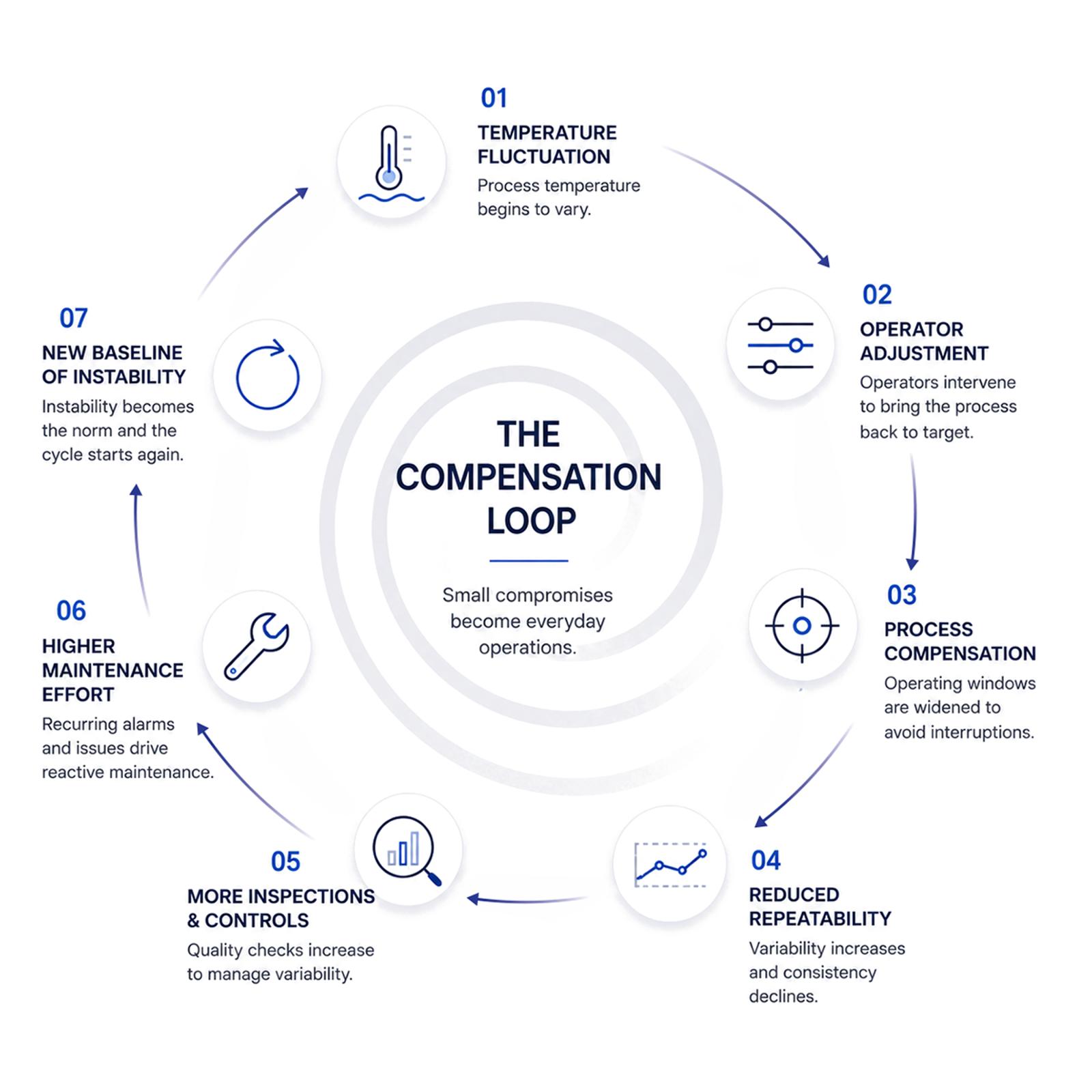
Instead of causing immediate failures, instability introduces small deviations that progressively affect the entire process. Operators compensate with manual adjustments, quality inspections increase, and process parameters are widened to reduce the risk of defects.
Over time, this leads to a situation where the process is no longer controlled but continuously corrected.
These effects rarely appear in a single department. Their cost is distributed across production, quality, maintenance, and energy consumption—making them harder to identify, but significant in the long run.
In many cases, the cooling system is not the obvious source of the issue. Yet it often represents one of the most effective levers for resolving it.
Why Traditional Chiller Selection Is No Longer Enough
Historically, industrial chillers were selected based on three primary criteria:
- Required cooling capacity
- Operating temperature
- Initial purchase cost
While still relevant, these parameters no longer reflect real operational performance
Two systems with identical nominal capacity can behave very differently once installed. The difference lies in how each system responds to changing thermal conditions.
A chiller that reacts slowly to load variations may create temperature oscillations. A system that cycles frequently may increase energy consumption and accelerate component wear.
For this reason, manufacturers are increasingly evaluating solutions based on performance in real conditions, including:
- Stability under variable loads
- Efficiency during partial operation
- Reliability in changing ambient conditions
- Integration with existing systems
- Long-term operating cost
This shift marks a clear evolution—from selecting equipment based on specifications to selecting solutions based on behavior over time.
It also explains why modern Air Cooled Liquid Chillers have evolved from simple refrigeration units into adaptive thermal management systems.
How Modern Air-Cooled Liquid Chillers Support Stable Processes
Stability Is the Result of an Entire System
Process stability is often associated with individual components, but in reality it is the result of system-wide interaction.
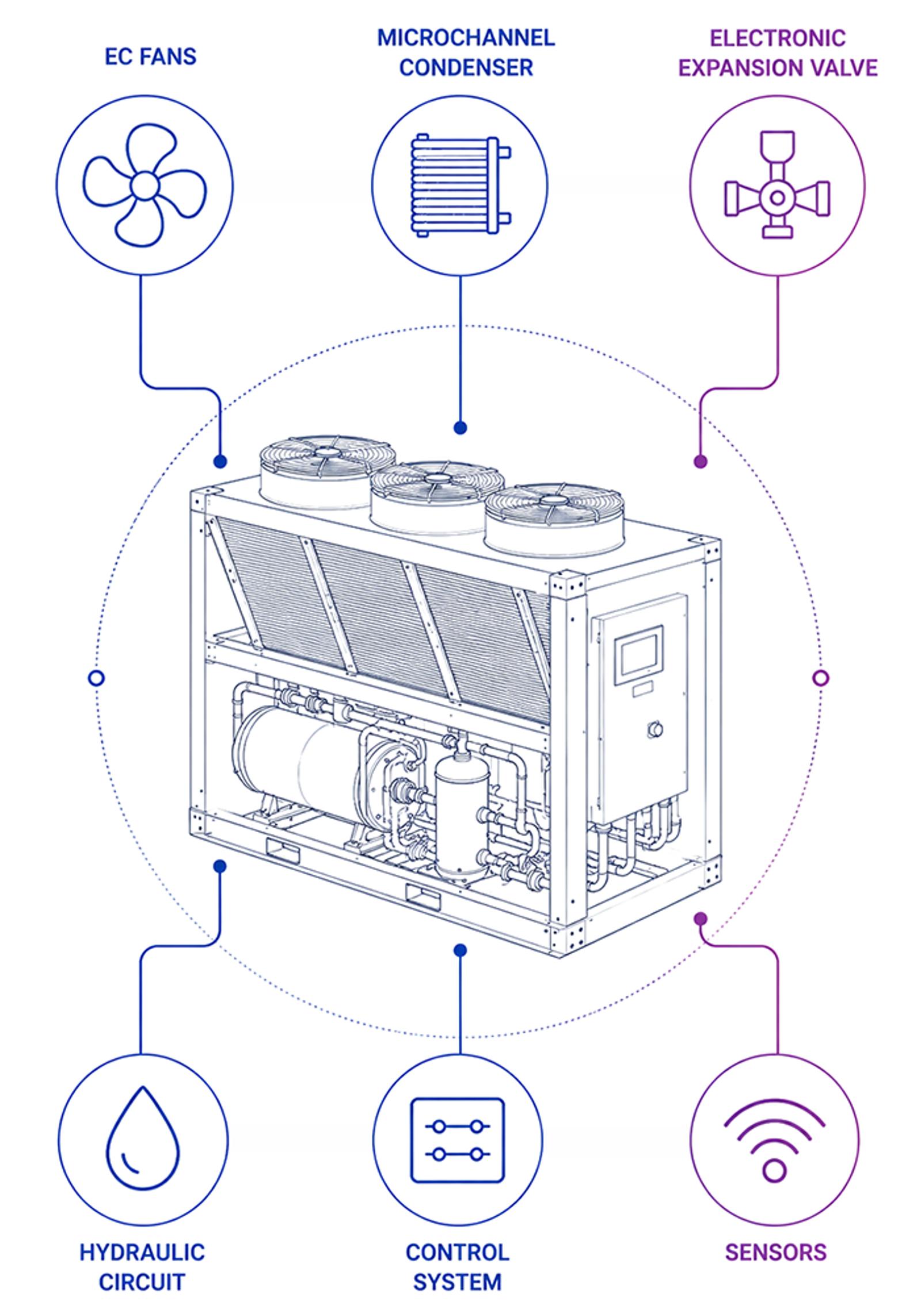
Efficient heat exchange, intelligent controls, accurate sensing, airflow management, and hydraulic design all work together to maintain equilibrium. Weakness in any of these areas can compromise overall stability.
For this reason, evaluating cooling systems purely on cooling capacity provides an incomplete picture. What truly matters is how the system behaves under real, fluctuating conditions.
Modern chillers are therefore designed to maintain predictable process conditions, not just to remove heat.
Heat Rejection and Airflow Management
Cooling performance depends not only on capacity, but on how efficiently heat is rejected—especially in air-cooled systems.
Technologies such as microchannel condensers improve heat transfer efficiency while reducing refrigerant charge, enabling more stable performance under varying ambient conditions. At the same time, EC fans dynamically adjust airflow, avoiding abrupt changes typical of traditional on/off operation.
This combination allows the system to respond more smoothly to thermal variations, improving both temperature consistency and energy efficiency.
The Role of Intelligent Controls
Mechanical performance alone is not sufficient. Stability increasingly depends on how the system reacts over time.
Modern control systems continuously monitor operating conditions and adjust performance in real time. Instead of reacting after deviations occur, they anticipate changes and apply gradual corrections, avoiding oscillations.
Sensors track key parameters such as temperature, pressure, and ambient conditions, allowing the system to operate based on actual process behavior rather than predefined assumptions.
Over time, this results in improved process consistency, reduced mechanical stress, and greater system reliability.
Hydraulic Stability as a Critical Factor
Even the most advanced chiller cannot ensure stability if the hydraulic system introduces variability.
In many installations, multiple users share the same circuit, creating fluctuating demand. Without proper balance and system design, these variations can translate into unstable process temperatures.
Typical issues such as inconsistent flow, poor balancing, or inadequate system volume do not originate within the chiller, yet they directly affect its performance.
This is why successful cooling strategies consider the entire installation—including hydraulics, pumps, storage, and process interaction—as a single integrated system.
From Stable Cooling to Better Business Performance
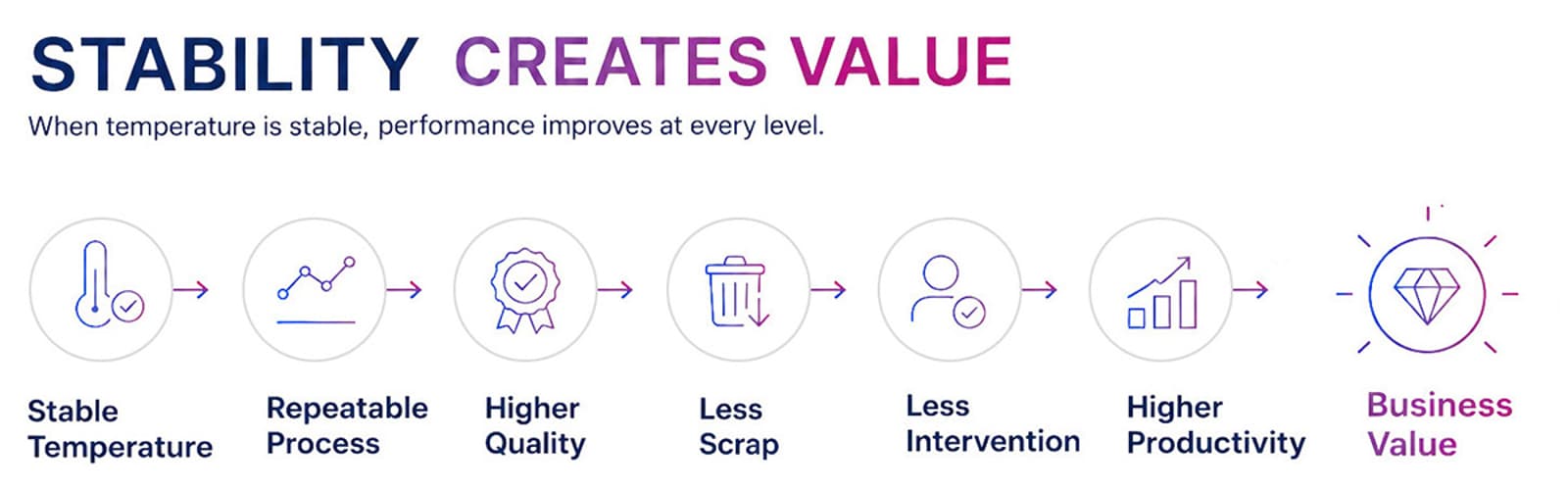
Stable temperature control does not create value on its own. Its importance lies in the improvements it enables across the production process.
When thermal conditions remain consistent, operations become more predictable. Product quality improves, operator intervention decreases, and production runs more smoothly. Maintenance activities also evolve, shifting from reactive troubleshooting toward planned optimization.
These benefits reinforce one another over time. Reduced variability leads to less waste, which improves efficiency and lowers costs. At the same time, production capacity increases as systems operate closer to optimal conditions.
Energy performance follows the same pattern.
Instead of reacting to instability with inefficient corrections, the cooling system operates steadily, avoiding unnecessary compressor cycles or excessive fan use. This results in lower energy consumption and reduced environmental impact.
Looking Beyond Initial Investment
The way cooling systems are evaluated is also evolving.
While purchase cost remains important, many manufacturers now adopt a Total Cost of Ownership (TCO) perspective. This includes energy consumption, maintenance, reliability, process efficiency, and equipment lifespan.
A system that delivers stable performance may require a higher initial investment, but it often generates significantly greater long-term value.
Thermal stability should therefore be considered not as a cost, but as an operational investment directly linked to profitability.

Designing for Long-Term Process Stability
Process stability is not achieved once and maintained indefinitely. Production environments change continuously—new lines are introduced, operating conditions evolve, and thermal demand shifts accordingly.
To sustain performance over time, manufacturers must adopt an approach that combines:
- Application-driven system design
- Proper integration with the production environment
- Real-condition commissioning
- Continuous monitoring and optimization
This perspective treats cooling not as isolated equipment, but as part of a broader thermal management strategy.
With over 35 years of experience, Friulair applies this philosophy to the design of Air Cooled Liquid Chillers, supporting manufacturers in achieving reliable and consistent performance across different applications.
Because ultimately, the most effective cooling system is not the most powerful—it is the one that maintains stable conditions every day, regardless of how production evolves.
Conclusion
As industrial processes become more complex, maintaining stable operating conditions is no longer optional.
Temperature stability directly influences quality, efficiency, energy consumption, and operational reliability. For this reason, manufacturers are increasingly moving beyond nominal specifications and focusing on real-world performance.
Modern Air Cooled Liquid Chillers play a central role in this shift, combining advanced engineering, intelligent control, and system integration to support consistent production environments.
Ultimately, process stability is not just about cooling. It is about creating manufacturing conditions where performance becomes predictable, efficiency improves, and competitiveness is sustained over time.
Ready to Explore Process Stability in Greater Depth?
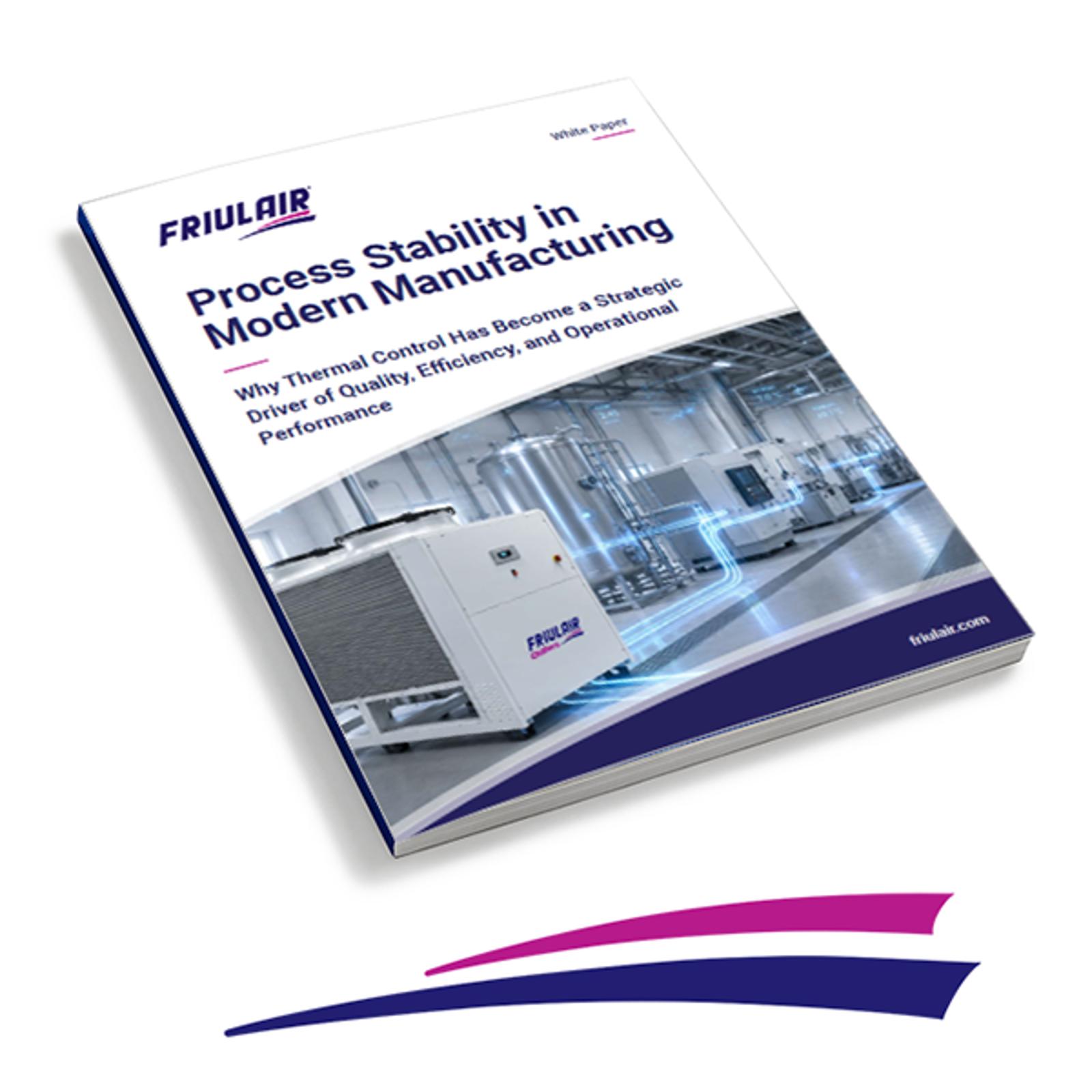
Download our white paper,"Process Stability in Modern Manufacturing"
- How modern cooling systems support process control rather than simply removing heat
- The engineering principles behind stable thermal management
- The operational and financial impact of thermal variability
- Best practices for designing cooling systems around real process behaviour